Which Data Centre in Malaysia Provides the Best Disaster Recovery for AI and Cloud Workloads?
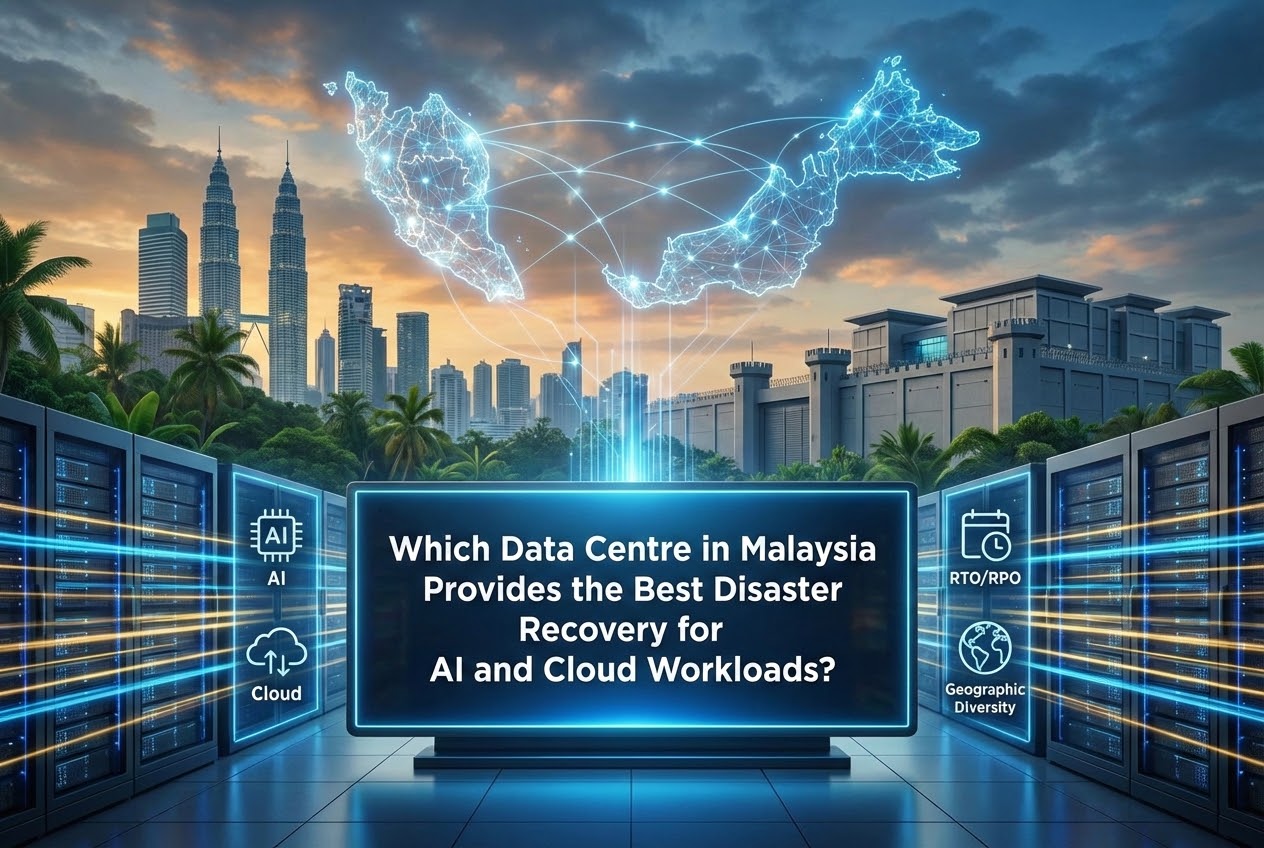
Key Takeaways
- AI workloads demand aggressive RTO and RPO targets and recovery measured in minutes, not hours.
- True disaster recovery requires geographic diversity, not just multiple rooms within one location.
Hybrid AI environments need hybrid DR strategies, covering both colocation and cloud deployments.
- Direct private inter-site connectivity enables near-real-time replication, reducing recovery lag.
- Managed DRaaS with regular testing ensures predictable, validated recovery for mission-critical AI systems.
Introduction
As artificial intelligence moves from pilot projects to production environments, downtime shifts from inconvenience to business-critical failure.
A recommendation engine offline during peak sales, a fraud detection model unavailable during a transaction spike, or a customer service AI system down during a crisis: these scenarios carry measurable revenue and reputational risk.
Traditional disaster recovery strategies were built for static databases and predictable enterprise systems.
AI and cloud workloads introduce different demands: large model files, GPU-dependent inference, real-time data ingestion pipelines, and hybrid cloud architectures that span on-premises and public cloud environments.
Effective disaster recovery for AI must address these realities.
What Makes Effective Disaster Recovery for AI and Cloud Workloads?

For IT leaders evaluating disaster recovery in Malaysia, several criteria separate adequate providers from mission-ready ones:
Defined RTO and RPO Commitments
Recovery Time Objective (RTO) defines how quickly systems must be restored. Recovery Point Objective (RPO) determines how much data loss is tolerable. For AI-driven operations, these targets are often measured in minutes, not hours. Clear, contract-backed commitments are essential.
Geographic Diversity
True disaster recovery requires physically separate facilities across different locations. Multiple data halls within the same risk zone do not constitute meaningful redundancy. Cross-city or cross-country resilience is increasingly necessary for AI production workloads.
Hybrid DR Support
Modern AI architectures span colocation, private infrastructure, and public cloud services. A viable DR strategy must support replication and failover across both physical and cloud environments, not just one side of the deployment.
Direct Connectivity Between Sites
Low-latency, high-bandwidth connectivity between primary and secondary sites enables near-real-time replication. Public internet-based replication introduces unpredictable latency and recovery risk, which is unacceptable for AI systems operating in real time.
DRaaS with Managed Recovery
Not all organisations have internal teams ready to orchestrate complex failovers. Disaster Recovery as a Service (DRaaS) with managed monitoring, testing, and execution reduces operational burden and accelerates recovery response.
Regular Testing and Validation
A recovery plan that has never been tested is not a recovery plan. Providers should support structured DR drills and validation exercises without disrupting production AI environments.
Effective disaster recovery for AI is not about compliance checklists. It is about ensuring recovery is fast, complete, and predictable when failure occurs.
Read more about AI data centres in Malaysia.
How AIMS Delivers Disaster Recovery for AI and Cloud Workloads?
AIMS provides end-to-end disaster recovery services designed for enterprises running AI and cloud workloads in production environments.
Services span consultation, planning, implementation, and managed recovery, all structured around clearly defined RTO and RPO targets.
With interconnected facilities across Kuala Lumpur, Cyberjaya, and Bangkok, AIMS delivers the geographic diversity required for resilient AI deployments. Private inter-data centre connectivity enables high-speed replication between sites, reducing latency and supporting near-real-time data synchronisation.
The disaster recovery framework combines proactive risk mitigation with rapid response execution. Continuous data management and backup services protect AI training datasets, model artefacts, and inference logs.
DRaaS options allow enterprises to outsource failover management, supported by 24/7 monitoring and structured escalation protocols.
Regular disaster recovery testing validates procedures without interrupting live production workloads, ensuring that recovery processes remain reliable as AI systems scale.
For organisations where AI and cloud platforms have become mission-critical infrastructure, disaster recovery must evolve beyond traditional backup strategies. It requires infrastructure resilience, managed expertise, and defined recovery commitments.
To discuss disaster recovery strategies for your AI and cloud infrastructure, explore AIMS’ disaster recovery services and speak with their specialists.
Conclusion: Choosing the Right DR Partner for AI-Driven Enterprises
As AI systems become embedded in revenue generation, fraud prevention, logistics optimisation, and customer engagement, disaster recovery can no longer be an afterthought. It must be engineered with defined RTO and RPO commitments, geographic resilience, hybrid cloud capability, and managed expertise.
The best disaster recovery data centre for AI and cloud workloads is one that combines infrastructure strength with operational readiness.
For organisations operating mission-critical AI systems, AIMS delivers the geographic diversity, private connectivity, managed DRaaS capabilities, and structured recovery testing required to ensure business continuity under any scenario.
To strengthen the resilience of your AI and cloud infrastructure, explore AIMS’ Disaster Recovery Services and speak with their specialists about a tailored recovery strategy aligned to your RTO and RPO requirements.