Colocation Vs Cloud: Which is Right for You
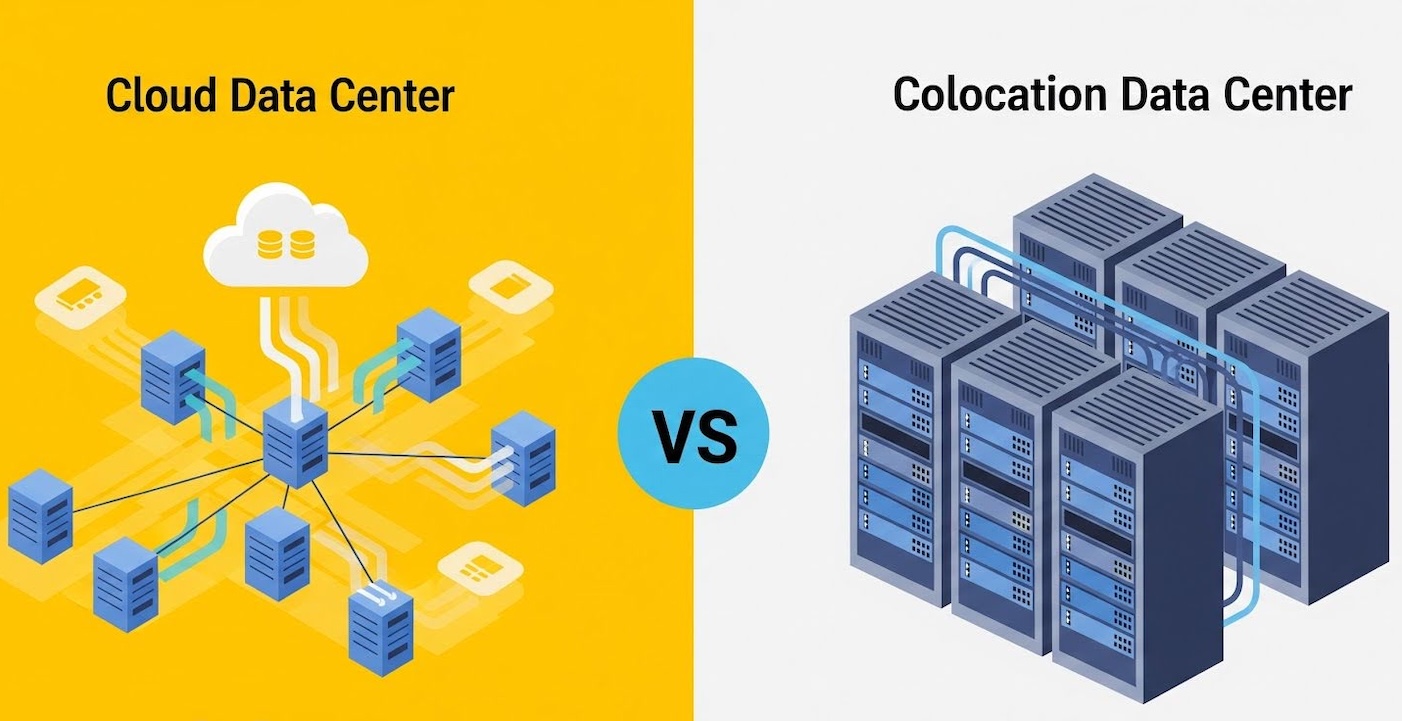
Cloud vs. Colocation Data Centre: Which is Right for Your Business?
Key Takeaways:
- Cloud computing offers scalability, low upfront costs, and ease of management, making it ideal for startups, SMEs, and businesses with fluctuating workloads.
- Colocation provides full control over hardware, enhanced security, and compliance support, suited for enterprises with high performance or regulatory needs.
- Cost structures differ: Cloud uses a pay-as-you-go model, while colocation requires higher initial investment but offers predictable recurring fees.
- Scalability is easier with cloud, while colocation demands physical upgrades for growth.
- Hybrid solutions combine cloud’s flexibility with co-location’s control, offering balance for complex IT requirements.
Introduction
Businesses in Malaysia’s rapidly evolving digital landscape are faced with a critical decision: should they embrace cloud computing or invest in colocation data centres?
Cloud computing and colocation data centres have emerged as transformative forces for businesses. They’ve fundamentally changed how enterprises manage, store, and access their data.
Notably, cloud computing offers several benefits, including scalability, flexibility, affordability, and the ability to facilitate rapid digital transformation. Cloud computing also enables small businesses to leverage the newest AI and edge computing technologies.
Colocation data centres offer companies the benefits of enterprise-grade security, high uptime, and reliable connectivity, all whilst maintaining physical control over their IT infrastructure.
This article explores the distinctions between cloud and colocation models, with a focus on performance, cost, security, and scalability.
What is Cloud Computing?
Cloud computing is a paradigm that revolves around the delivery of computing services over the internet (“the cloud”) to enable faster innovation and economies of scale. It allows companies to provide services on demand, without owning or managing physical infrastructure.
With the ability to rapidly provision resources with minimal effort, companies can innovate faster in today’s dynamic digital environment. Its key features include:
- On-demand resources: Users can automatically provision computing resources, such as server time and storage, without needing human interaction from the provider.
- Pay-per-use model: Users are only charged for the resources they consume.
- Global accessibility: Users can access services worldwide, from any device with an internet connection.
What is Colocation?
Colocation is the practice of a company storing its own IT hardware and servers in a third-party data centre instead of on-site. As such, companies can leverage the data centre’s cutting-edge electrical, cooling, network, and physical security systems while still maintaining complete control over their physical equipment.
Simply put, companies essentially rent a specific space, like racks, cabinets, or cages in a professionally maintained shared data facility. Key features of a colocation facility include:
- Dedicated physical space: This feature guarantees your servers have a secure, isolated environment tailored to your needs.
- Enhanced security: The facility offers 24/7 surveillance, access controls, and robust physical security measures to safeguard critical IT assets.
- Compliance support: They provide infrastructure that meets industry standards and regulations, enabling businesses to maintain data sovereignty and ensure audit readiness.
Pros and Cons of Cloud and Colocation Data Centres
Both cloud and colocation solutions offer unique advantages in terms of performance, security, cost, and scalability.
Pros of Cloud Computing
- Lower initial costs: Cloud computing eliminates the requirement for high upfront investments in hardware and infrastructure. As such, businesses can start with minimal capital expenditure.
- Scalability: Resources can be dynamically scaled up or down instantly based on demand, to handle traffic spikes.
- Ease of management: Cloud providers handle regular maintenance, updates, and infrastructure management.
- Global accessibility: Cloud services are widely accessible from anywhere with an internet connection. Thereby, supporting remote work and global operations.
- Pay-per-use model: Entities pay only for the resources they consume, optimising costs and avoiding waste.
- Improved collaboration and reliability: They ensure business continuity by offering built-in backups, disaster recovery, and multi-region failover.
Cons of Cloud Computing
- Potential ongoing costs: Although initial costs are low, ongoing expenses can increase unpredictably due to hidden fees.
- Less control over physical hardware: Users don’t own or directly manage the underlying infrastructure. This limits customisation and control.
- Security concerns: Storing sensitive data off-premises introduces risks, including data breaches, vendor vulnerabilities, and compliance challenges.
- Vendor lock-in: Migrating between cloud providers can be sophisticated and costly, potentially locking businesses into a single vendor’s ecosystem.
- Dependence on internet connectivity: Since cloud access requires reliable internet, outages or poor connectivity can disrupt access to critical services.
- Downtime risks: Cloud providers can experience unpredictable outages that temporarily affect service availability
Pros of Colocation
- Full control over hardware: Businesses can implement specific configurations as they maintain ownership and direct control of their physical servers.
- Enhanced physical security: Colocation data centres provide 24/7 surveillance, access controls, and environmental protections to safeguard hardware.
- Compliance support: Most colocation facilities meet strict industry standards and regulatory requirements to address data sovereignty and audit needs.
- Cost savings on infrastructure: By leveraging a third-party data centre’s power, cooling, and network infrastructure, businesses can prevent the high costs associated with maintaining their own data centres.
- Reliable power and connectivity: Colocation centres offer redundant power supplies and high-speed connectivity. Thereby, ensuring high availability and performance.
Cons of Colocation
-
- High upfront costs: In contrast to cloud services, colocation has higher upfront implementation costs.
- Limited scalability: Colocations cannot dynamically scale on demand. In essence, scaling dictates purchasing and installing additional hardware.
- Maintenance responsibilities: Businesses are responsible for managing, updating, and repairing their own equipment.
- Physical access requirements: Troubleshooting or hardware upgrades may require on-site presence
- Potential geographic limitations: Colocation depends on the physical location of the data centre, which may affect latency.
Cloud vs Colocation: A Comparison
Despite sharing similarities, cloud computing and colocation data centres differ in several ways:
Performance Comparison
Cloud computing offers high availability and redundancy by distributing workloads across disparate data centres and geographical locations. This guarantees uninterrupted service even in the event of breakdowns or outages.
Colocation offers reliable and consistent performance by leveraging dedicated resources and user proximity. This lowers latency and speeds up response times for customers nearby.
Cost Analysis
The pay-as-you-go, subscription-based pricing model of cloud services allows for dynamic flexibility. However, it can also result in unforeseen expenditures because it is dependent on resource consumption.
Colocation often results in cost reductions for high or consistently demanding workloads. However, it does need an upfront capital investment in servers and hardware, with predictable monthly fees for space and power.
For more cost comparisons, read ‘Colocation vs On-Premise Data Centres: A Cost-Benefit Analysis for Companies’
Security Considerations in Cloud and Colocation
Cloud customers have limited control over hardware and must rely on provider policies and shared responsibility models.
Companies benefit from the data centre’s physical security measures and compliance certifications whilst maintaining complete control over their hardware. They’re also allowed to implement custom security policies.
Scalability
Since they aren’t constrained by physical hardware, cloud providers offer exceptional scalability. This feature enables companies to scale up or down resources to meet fluctuating demands swiftly.
Compared to cloud solutions, colocation offers slower scalability and potentially higher costs. This is because it depends on the availability of physical space and necessitates the purchase and installation of additional equipment.
Cloud or Colocation: Which is Best for Your Business?
When choosing between colocation and cloud computing, knowing the common use cases for each will help you make an informed decision.
Businesses with varying workloads, startups, and small and medium-sized organisations (SMEs) are all best suited for cloud computing. Due to its pay-as-you-go pricing, low initial investment, and rapid scalability, small businesses can quickly deploy IT resources without incurring long-term commitments or high upfront fees.
Cloud services also simplify IT management by allowing providers to handle infrastructure maintenance. This consequently frees companies to focus on growth and innovation.
However, larger businesses or organisations with stringent management, compliance, and security requirements are better candidates for colocation data centres. For example, enterprises in the healthcare, financial, or regulated sectors.
Colocation can save costs for consistent, high workloads and help ensure compliance with data sovereignty and regulatory standards. If your business values control, customisation, and long-term infrastructure stability, look no further than AIMS’ Colocation facilities.
Hybrid Approach: Combining Cloud and Colocation
A hybrid strategy combines colocation data centres with cloud computing to maximise business performance and flexibility. In practice, this strategy leverages the advantages of both models.
For instance, businesses can leverage the cloud’s scalability and cost-effectiveness while maintaining control over sensitive data and critical workloads with colocation.
Companies can employ their own hardware in a colocation centre to run stable or compliance-sensitive applications. At the same time, they can utilise the cloud to manage varying workloads, bursting capacity, or cutting-edge services.
However, adopting a hybrid cloud and colocation strategy requires careful planning and integration. Organisations must design seamless connectivity between their on-premises or colocation infrastructure and cloud platforms. Furthermore, managing workloads across hybrid environments demand advanced orchestration tools and clear policies to optimise resource allocation, security, and compliance.
Despite these considerations, a well-executed hybrid approach offers enhanced agility, improved disaster recovery, regulatory compliance, and cost savings.
Conclusion
Cloud computing and colocation data centres both have unique benefits that meet various business requirements. Cloud computing is especially well-suited for startups, SMEs, and companies with varying or unpredictable workloads. This is because it excels at offering scalability, flexibility, and lower upfront expenses.
On the other hand, companies that require dedicated, high-performance infrastructure or have strict data sovereignty requirements can greatly benefit from colocations. Despite the greater initial expenditures and maintenance obligations, colocations offer direct control over physical assets and predictable recurring costs.
The decision between colocation and the cloud ultimately comes down to your company’s long-term objectives, budget, and unique needs. At AIMS Data Centre, we’re well-equipped to support you throughout this journey, ensuring the right solution for your business. Our colocation facilities provide secure, reliable, and scalable environments equipped with a durable infrastructure and connectivity options, designed to support businesses as they grow and meet compliance standards.
Get in touch with us for a consultation to explore your growth goals, compliance needs, and workload demands. Together, we’ll design a colocation solution that perfectly fits your business, giving you the control, security, and flexibility to thrive.